


Co-infusion of CD19-targeting and BCMA-targeting CAR-T cells for treatment-refractory systemic lupus erythematosus: a phase 1 trial
24 September 2025


Landmark N Engl J Med study showing that CD7 CAR-T bridging to allogeneic HSCT without GVHD prophylaxis is feasible and effective for T-ALL patients, opening a new curative pathway.
BACKGROUND: Patients with relapsed or refractory hematologic cancers have a poor prognosis. Chimeric antigen receptor (CAR) T-cell therapy as a bridge to allogeneic hematopoietic stem-cell transplantation (HSCT) has the potential for long-term tumor elimination. However, pre-HSCT myeloablation and graft-versus-host disease (GVHD) prophylaxis agents have toxic effects and could eradicate residual CAR T cells and compromise antitumor effects. Whether the integration of CAR T-cell therapy and allogeneic HSCT can preserve CAR T-cell function and improve tumor control is unclear.
METHODS: We tested a novel "all-in-one" strategy consisting of sequential CD7 CAR T-cell therapy and haploidentical HSCT in 10 patients with relapsed or refractory CD7-positive leukemia or lymphoma. After CAR T-cell therapy led to complete remission with incomplete hematologic recovery, patients received haploidentical HSCT without pharmacologic myeloablation or GVHD prophylaxis drugs. Toxic effects and efficacy were closely monitored.
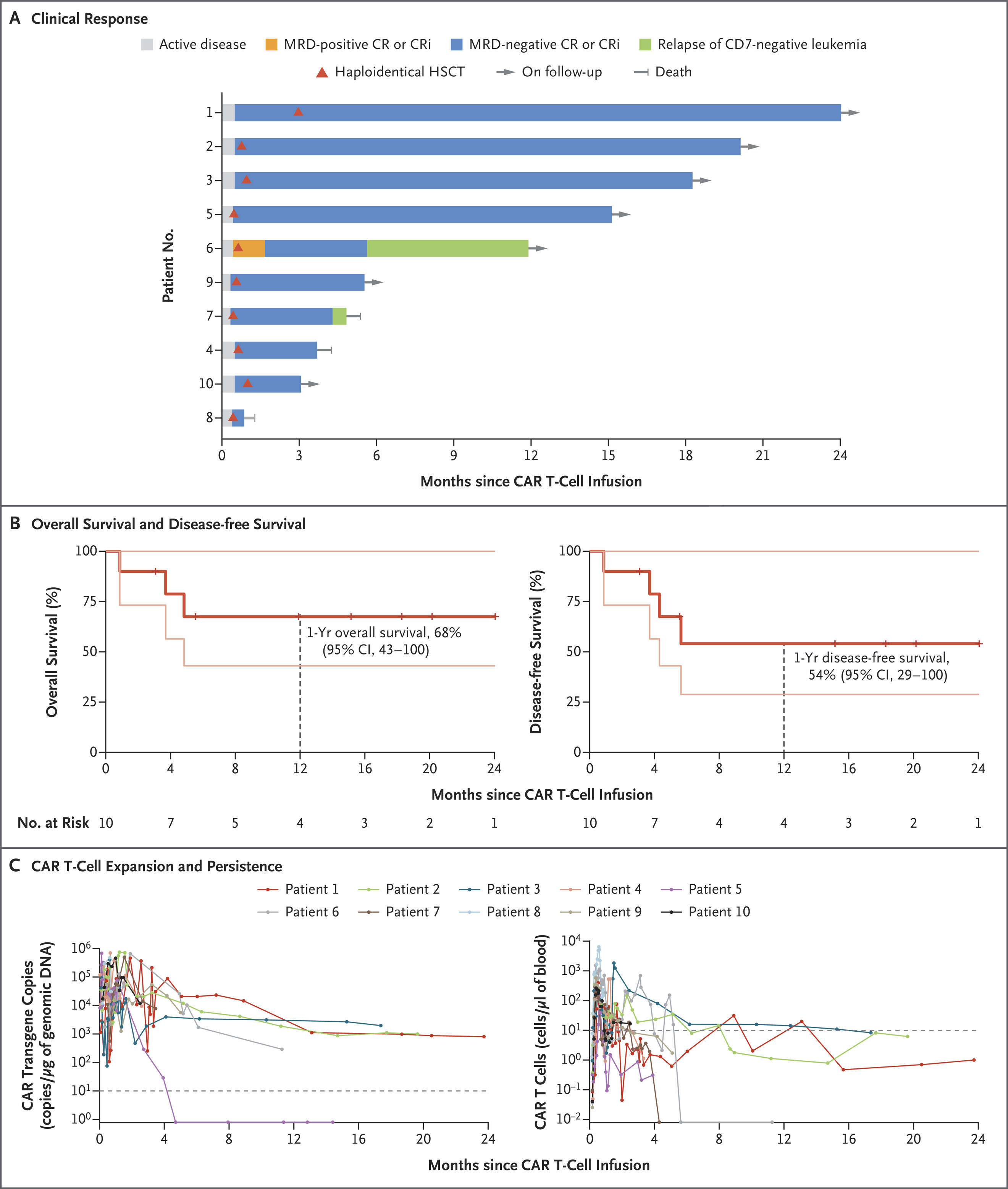
RESULTS: After CAR T-cell therapy, all 10 patients had complete remission with incomplete hematologic recovery and grade 4 pancytopenia. After haploidentical HSCT, 1 patient died on day 13 of septic shock and encephalitis, 8 patients had full donor chimerism, and 1 patient had autologous hematopoiesis. Three patients had grade 2 HSCT-associated acute GVHD. The median follow-up was 15.1 months (range, 3.1 to 24.0) after CAR T-cell therapy. Six patients remained in minimal residual disease-negative complete remission, 2 had a relapse of CD7-negative leukemia, and 1 died of septic shock at 3.7 months. The estimated 1-year overall survival was 68% (95% confidence interval [CI], 43 to 100), and the estimated 1-year disease-free survival was 54% (95% CI, 29 to 100).
CONCLUSIONS: Our findings suggest that sequential CD7 CAR T-cell therapy and haploidentical HSCT is safe and effective, with remission and serious but reversible adverse events. This strategy offers a feasible approach for patients with CD7-positive tumors who are ineligible for conventional allogeneic HSCT.
Journal: N Engl J Med. 2024 Apr 25.
Volume / Pages: 390(16):1467-1480
PubMed: PubMed: 38657244


