


Co-infusion of CD19-targeting and BCMA-targeting CAR-T cells for treatment-refractory systemic lupus erythematosus: a phase 1 trial
24 September 2025


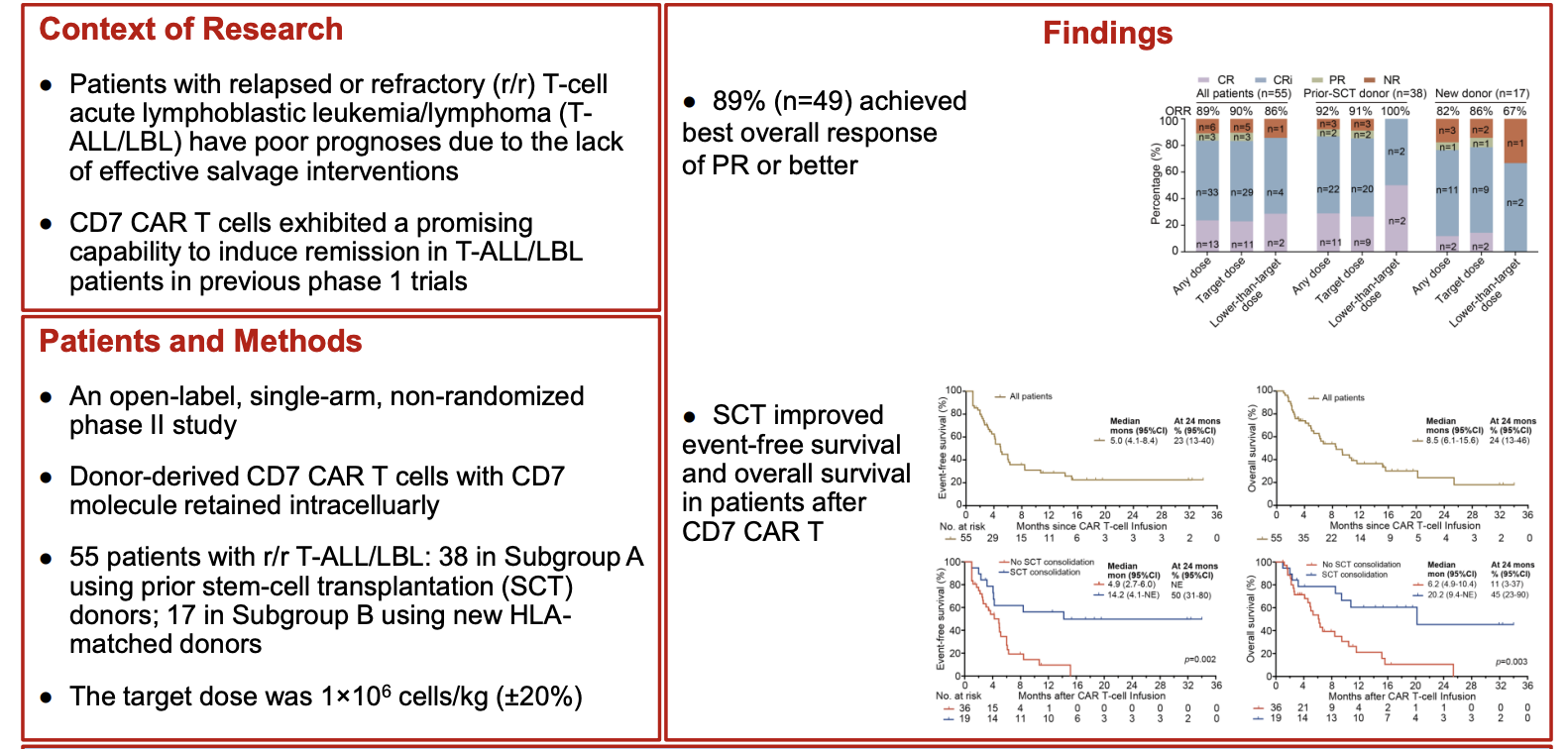
Phase 2 trial establishing donor-derived CD7 CAR-T as a highly effective salvage therapy for both pediatric and adult patients with relapsed/refractory T-cell acute lymphoblastic leukemia/lymphoma.
This phase 2 trial assessed CD7 chimeric antigen receptor (CAR) T cells derived from previous transplant or newly HLA-matched donors for relapsed/refractory T-cell acute lymphoblastic leukemia/lymphoma (T-ALL/LBL). Early termination from departmental closure yielded 55 treated patients out of 70 planned. Within 3 months, 89% of treated patients achieved best overall response of partial remission or better. A total of 19 received stem cell transplantation at a median of 1.3 (range, 1.0-10.6) months. After a 26.3-month median follow-up, median event-free survival was 5.0 months (95% confidence interval [4.1-8.4]), with median 8.5-month overall survival (95% confidence interval [6.1-15.6]). No deaths occurred within 30 days; adverse events included cytokine release syndrome in 87% at grades 1 to 2 and 11% at grade 3 and neurotoxicity in 9% at grade 1. In addition, graft-versus-host disease was in 38% at grades 1 to 2 and 2% at grade 3. Grades 1 and 2 infections occurred in 29%. Cytopenias occurred in 4% at grade 2 and 96% at grades 3 and 4. After 30 days, grades 3 to 5 adverse events included cytopenias (grade 3 in 24%; grade 4 in 67%), infections (grade 3 in 9%; grade 4 in 5%; grade 5 in 9%), graft-versus-host disease (grade 3 in 4%; grade 5 in 4%), thrombotic microangiopathy (grade 5 in 4%), and hepatic failure (grade 5 in 2%). Furthermore, 11 encountered nonrelapse mortality after 30 days, representing 20% of treated patients and 35% of responders without consolidatory transplantation. Although effective at inducing remission, death in remission beyond 30 days is a concern. This trial was registered at www.clinicaltrials.gov as #NCT04689659.
Journal: Blood. 2025 Dec 4.
Volume / Pages: 146(23):2745-2757
PubMed: PubMed: 40712157


